Jag arbetar främst med glas och keramik. Min praktik växer ur att stanna länge med ett material. Gjuta, blåsa, forma, testa, misslyckas, upprepa och uppleva världen genom mitt valda material. Glas som en slags avatar.I work primarily with glass and ceramics. My practice grows out of staying with material for a long time. Casting, blowing, forming, testing, failing, repeating and experiencing the world through my material of choice. Glass as a sort of avatar.
Jag är intresserad av hur minne, omsorg, arbete och liv uttrycks i materiella system. Hur form kan uppstå när digitala verktyg möter fysiska processer. 3D-modellering, generativa algoritmer och neurala nätverk blir sätt att organisera tanken. Glasgjutning, electroforming och formskapande blir sätt att ge tanken en kropp.I am interested in how memory, care, labour and life are expressed in material systems. How form can emerge when digital tools meet physical processes. 3D modeling, generative algorithms and neural networks become ways of organizing thought. Glass casting, electroforming and mold making become ways of giving that thought a body.
Jag växte upp i Sverige, bodde några år i Norge, studerade glasblåsning i Nybro i tre år och började sedan på Konstfack. Jag började skriva kod som barn, med The Sims-fusk och HTML-presentationer på stallet.se. Senare blev koden ett sätt att lösa praktiska problem i verkstaden. Sedan började den bete sig som ett material. Ett Python-skript och en gipsform har mer gemensamt än folk tror. Båda är behållare för något som ännu inte existerar.I grew up in Sweden, lived in Norway for some years, studied glassblowing in Nybro for three years, then entered Konstfack. I started writing code as a kid, entering The Sims cheats and making HTML presentations on stallet.se. Later, code became a way to solve practical problems in the workshop. Then it started behaving like material. A Python script and a plaster mold have more in common than people think. Both are containers for something that does not yet exist.
Jag skriver Python som jag blandar en sats. Jag debuggar som jag kallverkar. Skärmen och ugnen är inte varandras motsatser. De är två ugnar.I write Python the way I mix a batch. I debug the way I coldwork. The screen and the kiln are not opposites. They are two furnaces.
Den 4 april 2025 skapade och födde jag mitt största konstverk: min son. En glad, sömnig bebis som låter mamma jobba väldigt mycket.On April 4, 2025, I created and gave birth to my greatest piece of art: my son. A happy, sleepy baby who lets mummy do a lot of work.
Jag undersöker hur levande system kan genereras digitalt och sedan materialiseras i glas, metall och andra material. Övergången mellan kod och materia är ingen översättning. Det är en gjutprocess. Formen är algoritmen. Glaset är resultatet.I investigate how living systems can be generated digitally and then materialized in glass, metal and other materials. The transfer between code and matter is not a translation. It is a casting process. The mold is the algorithm. The glass is the output.
Jag tränar neurala nätverk på arkiv av mina egna skulpturer. Maskinen lär sig se mitt arbete. Sedan genererar den nya former som jag aldrig har gjort men som bär spår av allt jag har. Jag vandrar genom latent space som jag vandrar genom en skog. Vägen är inte förutbestämd. Landskapet är inlärt.I train neural networks on archives of my own sculptures. The machine learns to see my work. Then it generates new forms that I have never made but that carry traces of everything I have. I walk through latent space the way I walk through a forest. The path is not predetermined. The landscape is learned.
Jag bygger evolutionära simuleringar där digitala organismer tävlar, muterar och reproducerar sig. Deras kroppar är matematiska ytor. Deras beteende är emergent. Några av dem 3D-skriver jag ut och kopparbeläger via electroforming. Det digitala kräket får ett metallskinn. En omvänd födelse.I build evolutionary simulations where digital organisms compete, mutate and reproduce. Their bodies are mathematical surfaces. Their behavior is emergent. Some of them I 3D-print and copper-plate through electroforming. The digital creature acquires a metal skin. A birth in reverse.
Jag väljer ut de körbara raderna från mitt eget GitHub, de som tränar modeller, genererar bilder och skapar liv, och följer vad de producerar in i material. Koden slutar inte köras när den lämnat maskinen. Den bevaras. En hard copy.I select the executable lines from my own GitHub, the ones that train models, generate images and create life, and follow what they produce into material. The code does not run once it is out of the machine. It is kept. A hard copy.
Mänskliga:Human: Svenska (modersmål), engelska (flytande), norska nynorsk & bokmål (flytande), biblisk hebreiska (läsning), cebuano/tagalog (barnivå), franska, arabiska, ryska (i mitt mitokondrie)Swedish (native), English (fluent), Norwegian nynorsk & bokmål (fluent), Biblical Hebrew (reading), Cebuano/Tagalog (bar level), French, Arabic, Russian (in my mitochondria)
Maskinspråk:Machine: Python, JavaScript, PHP, C++, C#, HTML/CSS, SQL, R, OpenSCAD, GLSL
Digital materialitet · Evolutionära system · Morfogenes · Kod som material · Övergång mellan digitalt och fysiskt · Generativ konst · Materialminne · Cirkulation och process · Omsorg och arbete · Kroppar och livsformerDigital materiality · Evolutionary systems · Morphogenesis · Code as material · Transfer between digital and physical · Generative art · Material memory · Circulation and process · Care and labour · Bodies and life forms
Tre system förda in i material: ett evolutionärt ekosystem, nätverk tränade från grunden på mitt eget kameraarkiv, och en LoRA injicerad i en befintlig modell. Det de genererar förs över i glas, koppar, keramik och PLA. GitHub-repot är stenbrytarplatsen. Ugnen är kompilatorn. Omnämnd av @cprintjournal.Three systems carried into material: an evolutionary ecosystem, networks trained from scratch on my own camera roll, and a LoRA injected into an existing model. What they generate is transferred into glass, copper, ceramic and PLA. The GitHub repository is the quarry. The kiln is the compiler. Omnämnd av @cprintjournal.

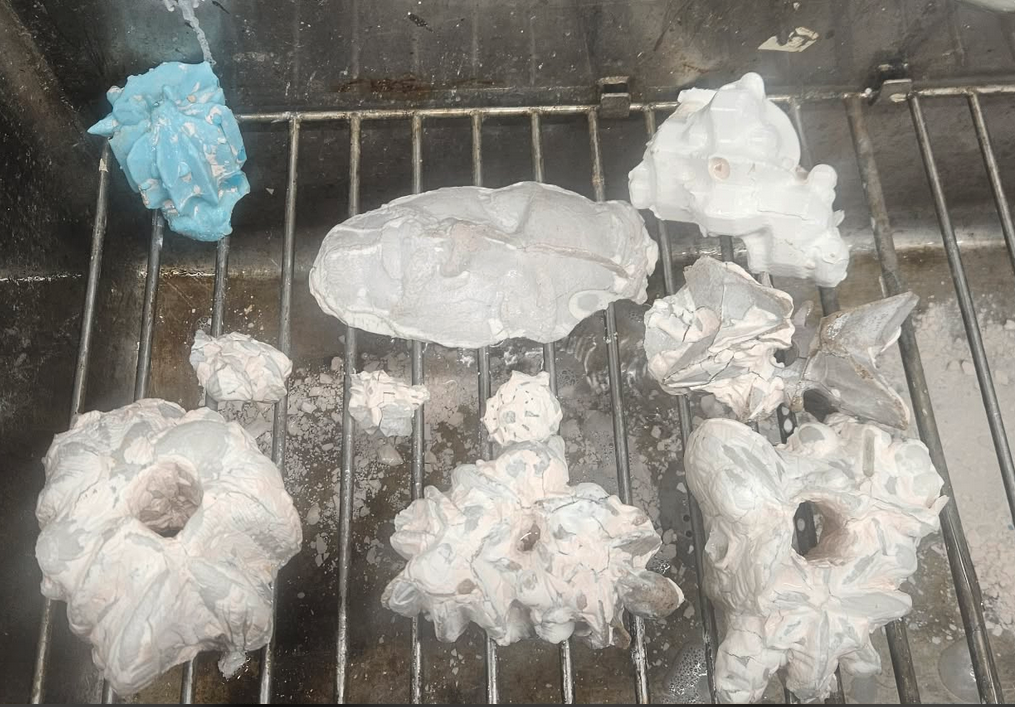
Ett blås ger två glas. Kupan blåses i en gipsform som sätter volymen, och ovanför formen svälls kappan ut fritt. Glaset spricker mitt i: den nedre delen blir ett dricksglas, kappan blir coupeskålen till ett partyglas, monterat varmt på ett skaft och en fot formad för hand. Det som annars hade gått tillbaka till smältan är en andra produkt. Perenn. Grundformen muterar mellan omgångarna.One blow gives two glasses. The cup is blown in a plaster mould that sets the volume, and above the mould the cap swells out freely. The glass is cracked at the middle: the lower part becomes a drinking glass, the cap becomes the coupe of a party glass, mounted warm on a stem and a foot formed freehand. What would otherwise go back to the melt is a second product. Perennial. The base form mutates between rounds.
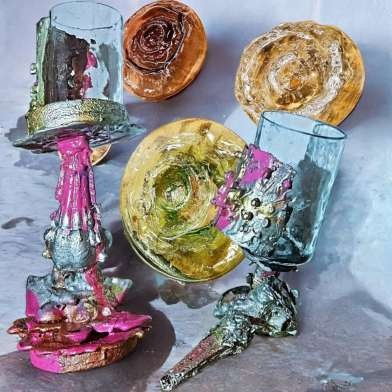
Glas- och keramikobjekt arrangerade i hushållsskala. Bordet som utställningsrum. Koppen som skulptur. Intimitet som metod.Glass and ceramic objects arranged in domestic scale. The table as exhibition space. The cup as sculpture. Intimacy as method.
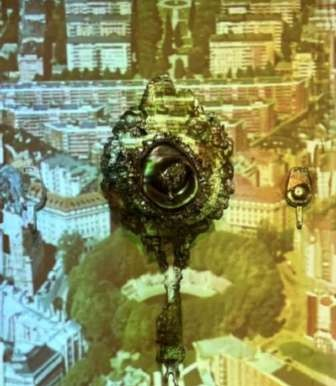
Utgångspunkt i en topografisk karta över Östermalm. Gjutet tenn, handblåst spegel med kromyta, tennfontän, videoprojektion. En del som representerar helheten. Fragment som skulptur. Det ofullständiga objektet som antyder allt det saknar.Starting from a topographic map of Östermalm. Cast tin, hand-blown mirror with chrome surface, tin fountain, video projection. A part standing for the whole. Fragment as sculpture. The incomplete object that implies everything it is missing.
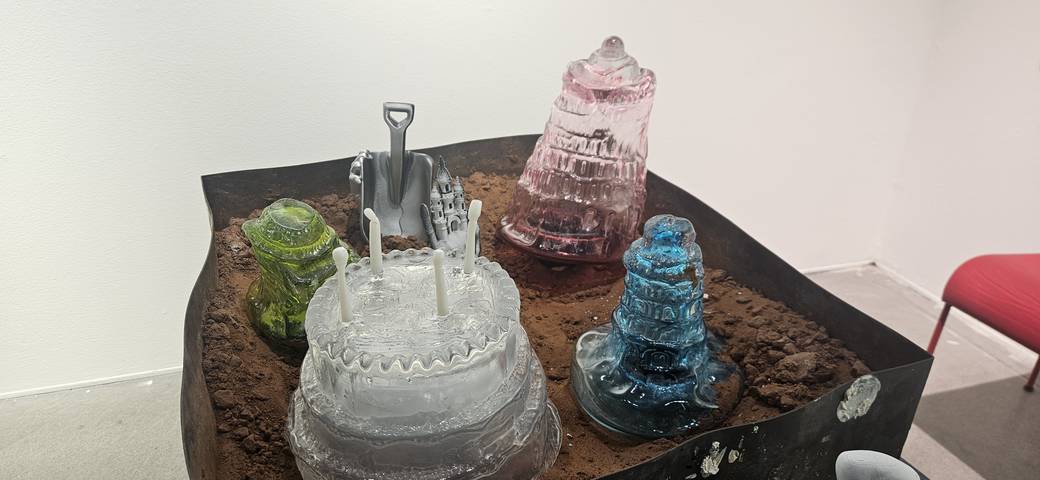
Rosa glas blåst i gips-kvartsform i sektioner. Tornform. Hot blowmold-teknik.Pink glass blown into gypsum-quartz mold in sections. Tower form. Hot blowmold technique.
Trelagerstårta i klarglas. Hot blowmold från gips-kiselform.Three-tier cake in clear glass. Hot blowmold from plaster-silica mould.
"Naturens glasblåsare, vi gör något vackert av det som gör ont." Gjutet glas, porslin, spegel."Nature's glassblowers - we make something beautiful out of what hurts." Cast glass, porcelain, mirror.
Blandad media, äkta och falskt. Tenn och glas gjutet från 3D-utskrivna former.Mixed media, real and fake. Tin and glass cast from 3D-printed forms.
Skampåk och korsett. Historiska begränsningsredskap översatta till skulptur. Glas, keramik, metall.Scolds bridle and corset. Historical restriction devices translated to sculpture. Glass, ceramic, metal.
Omvändbara tallrikar med rik sida och fattig sida. Miljöperspektiv på konsumtion.Reversible plates with rich-side and poor-side. Environmental perspective on consumption.
Glas blåst inuti keramikskal, interiör sprutlackad. Glas, keramik, metall, HIPS, PVC, sprutlack, projektion, video.Glass blown inside ceramic shell, interior spray painted. Glass, ceramic, metal, HIPS, PVC, spray paint, projection, video.
Hållare baserad på hjärnstam och indisk bönklocka. Glas, metall, PLA, pâte de verre, video.Holder based on brainstem and Indian prayer bell. Glass, metal, PLA, pâte de verre, video.
Skulptural installation. Paradiset förlorat, omformat.Sculptural installation. Paradise lost, re-formed.
Glas och mossa. Det organiska tar över det hantverkade.Glass and moss. The organic overtaking the crafted.
Brev till farfar använda som formar för glasblåsning. Papper vikt, doppat i vax, ingjutet i gips, bränt ut. Glasobjekten aktiveras med ljus via PIR-sensor och Raspberry Pi. Brevet försvinner. Glaset finns kvar.Letters to grandfather used as molds for glassblowing. Paper folded, dipped in wax, invested in plaster, burned out. The glass objects activate with light via PIR sensor and Raspberry Pi. The letter disappears. The glass remains.
Experimentell glasgjutglasforskning. Oxidkemi, COE-beräkningar, frit- och borosilikat-system för gjutning i gips-kiselformar. Zink-boratsystem. Kopparelechtrforming på glasytor.Experimental glass casting glaze research. Oxide chemistry, COE calculations, frit-based and borosilicate systems for casting in gypsum-silica molds. Zinc-borate systems. Copper electroforming on glass surfaces.
Fontänskulptur i blåst glas. En gristorso med mänskliga finger-spenar. Vitt vatten (falsk mjölk) cirkulerar genom kroppen. PLA som materiell ordvits. Det digitala (3D-utskrift) möter det analoga (blåst glas).Fountain sculpture in blown glass. A pig torso with human finger-teats. White water (fake milk) circulates through the body. PLA as material pun. The digital (3D-print) meets the analog (blown glass).
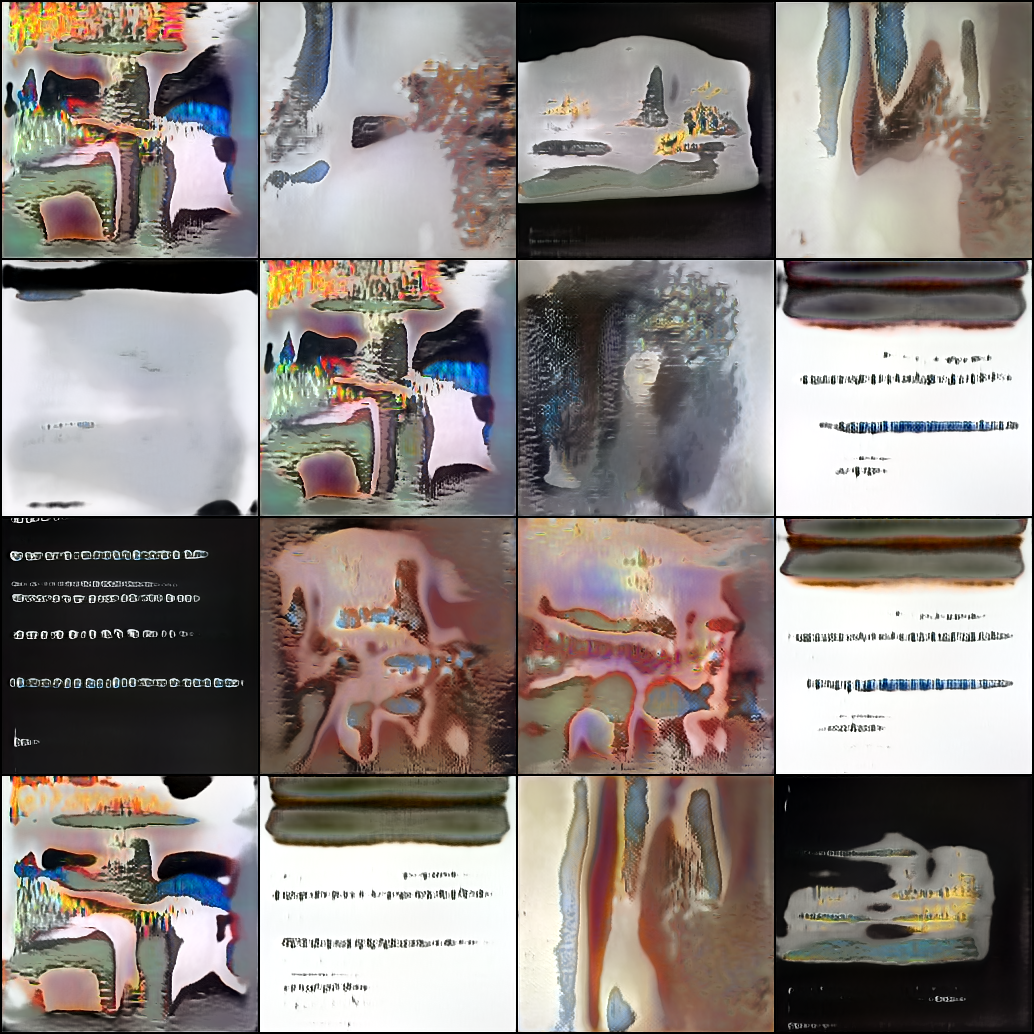
Ett progressivt GAN tränat från grunden på 7 843 personliga fotografier av mina egna skulpturer. 2 000+ GPU-timmar lokal träning på en GTX 1660 Super. Modellen lär sig progressivt, från 4x4 upp till 256x256. Varje upplösning avslöjar ny struktur. Latent space blir ett landskap. Z-vektorn är fröet. Generatorn är formen. Uppskalad till 4096px via Real-ESRGAN.A progressive GAN trained from scratch on 7 843 personal photographs of my own sculptures. 2 000+ GPU hours of local training on a GTX 1660 Super. The model learns progressively, from 4x4 up to 256x256. Each resolution reveals new structure. The latent space becomes a landscape. The z-vector is the seed. The generator is the mold. Upscaled to 4096px via Real-ESRGAN.
En autonom AI-agent för experimentplanering i min_bild_ai. Analyserar hela träningshistoriken, föreslår nästa experiment, förhindrar upprepade misslyckanden. Bash-alias: sculptor. Maskinen planerar sin egen evolution.An autonomous AI agent for experiment planning in min_bild_ai. Analyzes entire training history, proposes next experiments, prevents repeated failures. Bash alias: sculptor. The machine plans its own evolution.
LoRA-finjustering av Stable Diffusion på eget konstarkiv. Stilöverföring med triggerordet "nadja_art". Kollage-generering, videosyntes via Wan2GP. PeftModel merge pipeline.LoRA fine-tuning of Stable Diffusion on own art archive. Style transfer with "nadja_art" trigger word. Collage generation, video synthesis via Wan2GP. PeftModel merge pipeline.
Alternativ lättvikts-GAN-arkitektur. Inramad vandring med GAN-processvisualisering som ram. Träningsprocessen i sig blir konstverket.Alternative lightweight GAN architecture. Framed walk with GAN process visualization as border. The training process itself becomes the artwork.
NVIDIA-arkitekturer tränade på personliga dataset. Latent space-interpolation, trunkationsexperiment, stilmixning.NVIDIA architectures trained on personal datasets. Latent space interpolation, truncation experiments, style mixing.
Pipeline för bild-till-video-morfning. Lokala och Colab-baserade arbetsflöden. Kedjad slumpmässig morfning, selenium-kontroller för moln-GPU-sessioner.Image-to-video morphing pipeline. Local and Colab-based workflows. Chain random morphing, selenium controller for cloud GPU sessions.
Publicerat GitHub-projekt. Slumpmässiga vandringar och gradienttraversering genom GAN latent space, visualiserade som video. Vägen genom möjligheternas rymd, inspelad.Published GitHub project. Random walks and gradient traversal through GAN latent space, visualized as video. The path through possibility space, recorded.
Rymdvandringsvideo som kombinerar astronautbilder, disco och rullande körbar kod. GAN-modellens mamma, flytande genom rymden. 10-minutersversion planeras.Space walk video combining astronaut footage, disco, and scrolling executable code. The GAN's mother, floating through space. 10-minute version planned.
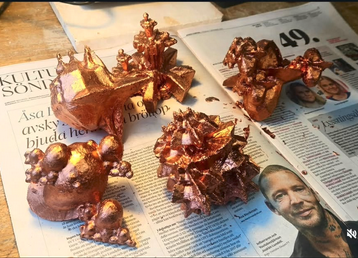
Organismer genererade från Gielis superformula-parametrar, 3D-utskrivna i PLA och kopparbelagda via electroforming. Kopparjoner deponeras atom för atom. Det matematiska kräket får ett metallskinn, en vikt, en temperatur. En omvänd födelse: från ekvation till objekt.Organisms generated from Gielis superformula parameters, 3D-printed in PLA and copper-plated through electroforming. Copper ions deposit atom by atom. The mathematical creature acquires a metal skin, a weight, a temperature. A birth in reverse: from equation to object.
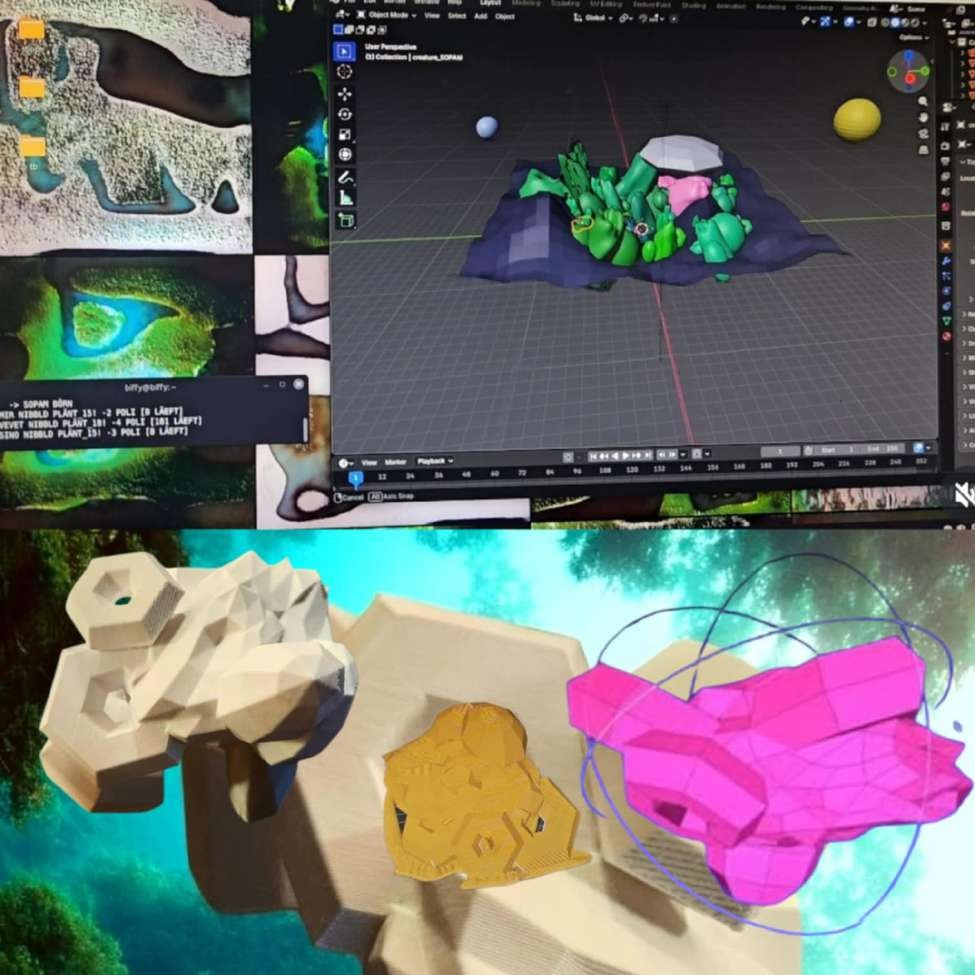
Ett evolutionärt digitalt ekosystem där organismer byggda av Gielis superformulas tävlar, muterar och reproducerar sig. 32-parameter-DNA-system, sexuell reproduktion, mutation. Femdelade kräk (PENTAD) med emergent beteende. 539+ STL-filer genererade (2,2 GB). Organismer har svenska namn: BOKA, GLIF, ZOMPA. Skrivet i Python, visualiserat i Three.js, utställt som webbinstallation. GitHub: jinkieyz/lajfi.An evolutionary digital ecosystem where organisms built from Gielis superformulas compete, mutate and reproduce. 32-parameter DNA system, sexual reproduction, mutation. Five-segment creatures (PENTAD) with emergent behavior. 539+ STL files generated (2.2 GB). Organisms have Swedish names: BOKA, GLIF, ZOMPA. Written in Python, visualized in Three.js, exhibited as web installation. GitHub: jinkieyz/lajfi.
Den första livsformen. En-kropp Gielis-kräk. Fröet ur vilket allt växte.The first life form. Single-body Gielis creature. The seed from which everything grew.
Tre-kroppsfusions-organismer. Tre LAJF-kräk sammanslagna till en sammansatt kropp.Three-body fusion organisms. Three LAJF creatures merged into one composite body.
Filamentbaserade organismer. Tunna, sträckta, sökande. Nio exemplar genererade.Filament-based organisms. Thin, stretched, reaching. Nine specimens generated.
Headless organismagenerator. Producerar LAJFI-kräk i serie för utställning, tryck och arkiv. Ultra256v2 med Taubin-utjämning. Cirka 60 livsformer genererade. Fabriksgolvet för digital biologi.Headless organism generator. Batch-produces LAJFI creatures for exhibition, print and archive. Ultra256v2 with Taubin smoothing. ~60 life forms generated. The factory floor of digital biology.
Femdelade kräk med Perlin noise-ytedistorsion. 39 naturmonster genererade. Den mest komplexa kroppskonstruktionen i ekosystemet.Five-segment creatures with Perlin noise surface distortion. 39 naturmonster generated. The most complex body plan in the ecosystem.
Den ultimata fusionen: Perlin noise möter Gielis superformula. Alla tidigare evolutionära grenar kombinerade.The ultimate fusion: Perlin noise meets Gielis superformula. All previous evolutionary branches combined.
Utställningsutgåva av LAJFI. PyGame + OpenGL, 1280x720, 30 FPS, krom-färgpalett. Byggd för galleridisplay.Exhibition edition of LAJFI. PyGame + OpenGL, 1280x720, 30 FPS, chrome color palette. Built for gallery display.
Fyra webbdemos: PS2 Demo (retro VGA, CRT-effekter, utställningsversion), God Mode (interaktiv parameterredigerare), Simulator (full evolution), PyQt5 Viewer (skrivbordsapp).Four web demos: PS2 Demo (retro VGA, CRT effects, exhibition version), God Mode (interactive parameter editor), Simulator (full evolution), PyQt5 Viewer (desktop app).
Kopparbelagda organismer som glider över en spegel via dolda magneter, sanden samlar spår av rörelsen. Ryckiga, levande rörelser.Copper-plated organisms gliding across a mirror via hidden magnets, sand collecting traces of the movement. Jerky, alive-looking movement.
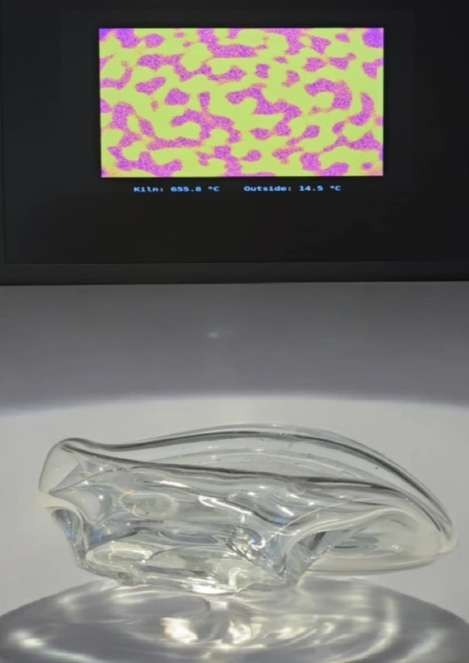
Glasskulpturer genererade ur verkliga data. Väderdata från SMHI/Bromma under veckan då mitt barn föddes styrde ugnsbrändningskurvorna. Sju identiska glasformar körda genom sju unika temperaturkurvor. Resultat: nästan identiska objekt med subtila skillnader i sprickor, transparens, bubblor. Geografi blir geometri blir glas.Glass sculptures generated from real-world data. Weather data from SMHI/Bromma from the week my child was born controlled kiln firing curves. Seven identical glass forms run through seven unique temperature curves. Result: almost identical objects with subtle differences in cracks, transparency, bubbles. Geography becomes geometry becomes glass.
WiFi-reaktiv videoinstallation. Rörelse stör bilden via ESP32-C6 som mäter Channel State Information. Kroppar detekterade via radiovågor. Närvaro utan kameror. CRT-liknande distorsionseffekter. Publicerad på GitHub.WiFi-reactive video installation. Movement disturbs the image via ESP32-C6 measuring Channel State Information. Bodies detected through radio waves. Presence without cameras. CRT-like distortion effects. Published on GitHub.
Radiosignalstyrka renderad som stjärnbilder. Datavisualisering som en form av samtidspoesi.Radio signal strength rendered as constellations. Data visualization as a form of contemporary poetry.
Ett personligt arkiv av 3D-modeller som spänner över organismer, skulpturer, formar, verktyg och experiment. Genererade via Blender-skriptning, OpenSCAD och parametrisk Python. Det digitala stenbrottet ur vilket fysiskt arbete utvinns.A personal archive of 3D models spanning organisms, sculptures, molds, tools and experiments. Generated via Blender scripting, OpenSCAD, and parametric Python. The digital quarry from which physical work is extracted.
33+ genererade 3D-skulpturer. En pipeline för snabb prototypframtagning av konceptuella former. Varje prompt är en gjutinstruktion till maskinen.33+ generated 3D sculptures. A pipeline for rapid prototyping of conceptual forms. Each prompt is a casting instruction for the machine.
Parameter-genererade Gielis sandformar i Blender. STL-export för CNC eller 3D-utskriftsmönster använda vid aluminiumsandgjutning.Parameter-generated Gielis sand molds in Blender. STL export for CNC or 3D-print patterns used in aluminum sand casting.
Egna Blender Python-skript: gielis_terrain.py, lajfi_fossils.py, lajfi_torus.py, gielis_ascii.py. Verkstaden förlängd in i kod.Custom Blender Python scripts: gielis_terrain.py, lajfi_fossils.py, lajfi_torus.py, gielis_ascii.py. The workshop extended into code.
Python GUI för att generera glasgjutningsformar som STL. Automatisk luftkanalplacering (topp, sida, botten), 3D-förhandsvisning, reglerad rendering. Finns även som webbversion.Python GUI for generating glass casting molds as STL. Automatic air channel placement (top, side, bottom), 3D preview, throttled rendering. Also available as web version.
Silikonformtillverkning för glasformer. img2img-morfningsexperiment på silikonTexturer.Silicone mold making for glass forms. img2img morphing experiments on silicone textures.
Väggplattor i OpenSCAD/STL designade för ler-3D-utskrift. Digital fil till keramiskt resultat.Wall plates in OpenSCAD/STL designed for clay 3D printing. Digital file to ceramic output.
Personlig webbplats byggd som en Windows 95-skrivbordssimulering. HTML/CSS/JS, inga ramverk. Dragbara fönster, startanimation, startmeny, ASCII-konst, regn-animation, påskägg. Hostad på STRATO via SFTP. 25+ undersidor med interaktiva verktyg.Personal website built as a Windows 95 desktop simulation. HTML/CSS/JS, no frameworks. Draggable windows, boot animation, start menu, ASCII art, rain animation, easter eggs. Hosted on STRATO via SFTP. 25+ subpages including interactive tools.
Glaskemiräknare. Stökiometri för glasrecept. Oxidprocent, UMF (Unity Molecular Formula), batch-till-formel-konvertering.Glass chemistry calculator. Stoichiometry for glass recipes. Oxide percentages, UMF (Unity Molecular Formula), batch-to-formula conversion.
Webbapp för keramisk bränning och lerplanering. Ikonbaserat gränssnitt. Inkluderar dokumentation om ler-3D-utskriftsforskning.Web app for ceramic firing and clay planning. Icon-based interface. Includes clay 3D printing research documentation.
Three.js-baserad STL-visare med export. Visar organiska Gielis-former i webbläsaren. Används för organisminspektionoch delning.Three.js-based STL viewer with export. Displays organic Gielis forms in the browser. Used for organism inspection and sharing.
Kryptogrampusselspel. Progressive Web App i vanilla JavaScript. Offline-stöd, highscore-system. Android APK byggd. Ordet som chiffer.Cryptogram puzzle game. Progressive Web App in vanilla JavaScript. Offline support, highscore system. Android APK built. The word as cipher.
Fildelningskatalog på vetroal.se. PDF:er, STL:er, videor, APK:er. Används när Thunderbird-bilagor inte fungerar på telefonen.File sharing directory on vetroal.se. PDFs, STLs, videos, APKs. Used when Thunderbird attachments fail on phone.
Raspberry Pi 5-baserad Pip-Boy-replik. Android-app (Java/Gradle), vault_tec_os med egna APK:er och skript. Baserad på Fallout 4 Pip-Boy MkIV-designen. Bärbar dator som cosplay-ingenjörskonst.Raspberry Pi 5-based Pip-Boy replica. Android app (Java/Gradle), vault_tec_os with custom APKs and scripts. Based on Fallout 4 Pip-Boy MkIV design. Wearable computing as cosplay engineering.
Pi som tunn klient. Sunshine/Moonlight-spelströmning från skrivbordet, N64-emulering (Zelda: OoT), mediacenter. Ingenting lagrat lokalt.Pi as thin client. Sunshine/Moonlight game streaming from desktop, N64 emulation (Zelda: OoT), media center. Nothing stored locally.
Smart 5D Hologram Fan (F-Mini 4,72 tum). Djup reverse engineering av .bin-formatet (ee34 magic, polar-kodning, moldskrambling). .NET-dekompilering av 5DDisplayer.exe. GANTASTIC-latent-walks visade som flytande hologram. SD-kortsåterställning med photorec.Smart 5D Hologram Fan (F-Mini 4.72"). Deep reverse engineering of .bin format (ee34 magic, polar encoding, mold scrambling). .NET decompilation of 5DDisplayer.exe. GANTASTIC latent walks displayed as floating holograms. SD card recovery with photorec.
32x32 BLE LED-panel (IDM-AD1394). Pixelkonstdisplay för generativa bilder. Kräver pixelkonsttänkande, inte matematiska kurvor.32x32 BLE LED panel (IDM-AD1394). Pixel art display for generative visuals. Requires pixel-art thinking, not mathematical curves.
Lenovo-surfplatta som kioskdisplay via FreeKiosk. Kalender, busstider (SL API), händelser. PHP API-backend. ADB-kontrollerad. Hemmet som gränssnitt.Lenovo tablet as kiosk display via FreeKiosk. Calendar, bus times (SL API), events. PHP API backend. ADB-controlled. The home as interface.
PIR-rörelsesensor + Raspberry Pi aktiverar ljus inuti glasgjutna bokstäver. Närvaro utlöser minne.PIR motion sensor + Raspberry Pi activating light inside glass-cast letters. Presence triggers memory.
ESP32-mikrokontroller som mäter WiFi Channel State Information för Carried Stillness Intruder-installationen. Radiovågor som konstnärligt medium.ESP32 microcontroller measuring WiFi Channel State Information for the Carried Stillness Intruder installation. Radio waves as artistic medium.
Kompositioner i IDM, microsound, drum and bass och elektroakustiska stilar. Ljud som material och process. Frekvensformning, sidokomprimering, loudness-normalisering. WAV-produktion.Compositions in IDM, microsound, drum and bass, and electroacoustic styles. Sound as material and process. Frequency carving, sidechain compression, loudness normalization. WAV production.
Drum and bass jungle-remixprojekt. Sycamore-originalet ombearbetat via breakbeat-kirurgi.Drum and bass jungle remix project. Sycamore original reprocessed through breakbeat surgery.
Universitetskurs i ljuddesign för film vid Blekinge Tekniska Högskola. Avklarad 2023.University course in sound design for film at Blekinge Tekniska Högskola. Completed 2023.
class Nadja:
    materials  = ["glass", "ceramic", "copper", "PLA", "aluminum", "tin"]
    languages  = ["Python", "JS", "PHP", "C++", "C#", "SQL", "R", "GLSL"]
    tools      = ["Blender", "ffmpeg", "Three.js", "PyTorch", "OpenSCAD"]
    ai_models  = ["ProgressiveGAN", "StyleGAN2/3", "FastGAN", "LoRA", "VQVAE"]
    human_lang = ["sv", "no", "en", "fr", "ar", "he", "ceb"]
    files      = {"py": 858, "sh": 714, "stl": 2039, "html": 77, "repos": 9}

    def practice(self):
        while True:
            idea = self.observe()
            model = self.train(idea)      # 2 000+ GPU hours
            form = self.generate(model)   # latent space walk
 self.cast(form) # kiln
GitHub: github.com/jinkieyz
Repos: LAJFI, latent_space_walker, Carried Stillness Intruder, HOLI, extern_ai, FUSHOLIPENT, GEMESIS
System:System: Linux Mint 22.2, GTX 1660 Super 6GB, i5-9400F, 8GB RAM. Varje modell tränad lokalt. Inget moln. Inga hyrda GPU:er.Every model trained locally. No cloud. No rented GPUs.
Egna verktyg:Custom tools: gpu_check.sh (freeze-prevention)(freeze prevention), safe_ffmpeg.sh (säker videokodning)(safe video encoding), sculptor (autonom träningsagent)(autonomous training agent), quest (CLI interface)
Frilansverksamhet: 3D-modellering (Blender, OpenSCAD), programmeringslösningar (Python, JavaScript, webb), glasblåsning och kallverkstad, glasbeställningar (vaser, bröllopsglas, gåvor).Freelance practice: 3D modeling (Blender, OpenSCAD), programming solutions (Python, JavaScript, web), glassblowing and coldwork, custom glass orders (vases, wedding glasses, gifts).
Glasblåsningskampanj för de kinesiska och indiska marknaderna. Kommersiell glasproduktion i industriell skala.Glassblowing campaign for the Chinese and Indian markets. Commercial glass production at industrial scale.
Årlig försäljning av handgjorda glasobjekt på Konstfacks julmarknad.Annual sale of handmade glass objects at Konstfack Christmas market.
Glasförsäljning på Ölands julmarknad under Riksglasskolans period.Glass sales at Öland Christmas market during Riksglasskolan period.
Volontär matutdelning. Ungefär två år. Innan glaset kom brödet.Volunteer food distribution. Approximately two years. Before the glass, there was bread.
Beviljat 2026.Granted 2026.
Flera tilldelningar.Multiple awards.
Ansökan inlämnad maj 2026.Application submitted May 2026.
Young & Loving 2026. GEMESIS-projektet. Ansökan inlämnad, väntar besked juni 2026.Young & Loving 2026. GEMESIS project. Application submitted, awaiting decision June 2026.
Konstnärsresidens-ansökan. Gielis superformula möter glasbruk möter återvunnet material. Väntar besked juni 2026.Artist residency application. Gielis superformula meets glassworks meets recycled material. Awaiting decision June 2026.
@cprintjournal (Instagram) – Omnämnd av C-Print Journal, samtida konstmagasin baserat i Stockholm.Mentioned by C-Print Journal, contemporary art magazine based in Stockholm.
Barometern – Artikel om "Rumproligt", Öland. (Namnet felstavat i tryck.)Article about "Rumproligt", Öland. (Name misspelled in print.)