Latent Space Walk (2026)
Hot blowmold, coloured glass, plaster-quartz forms
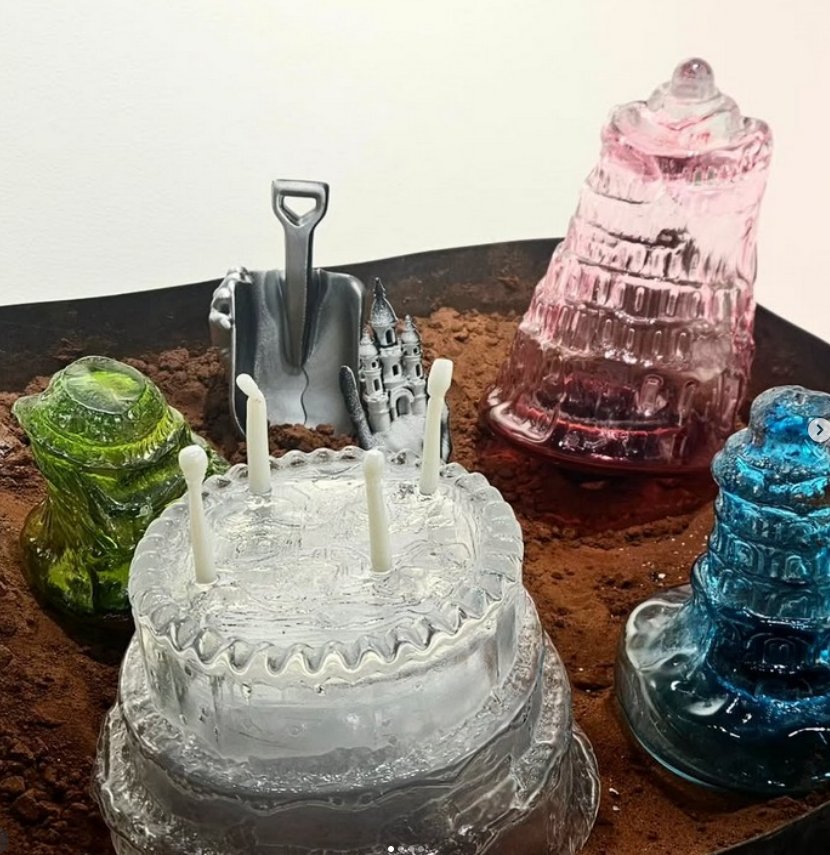
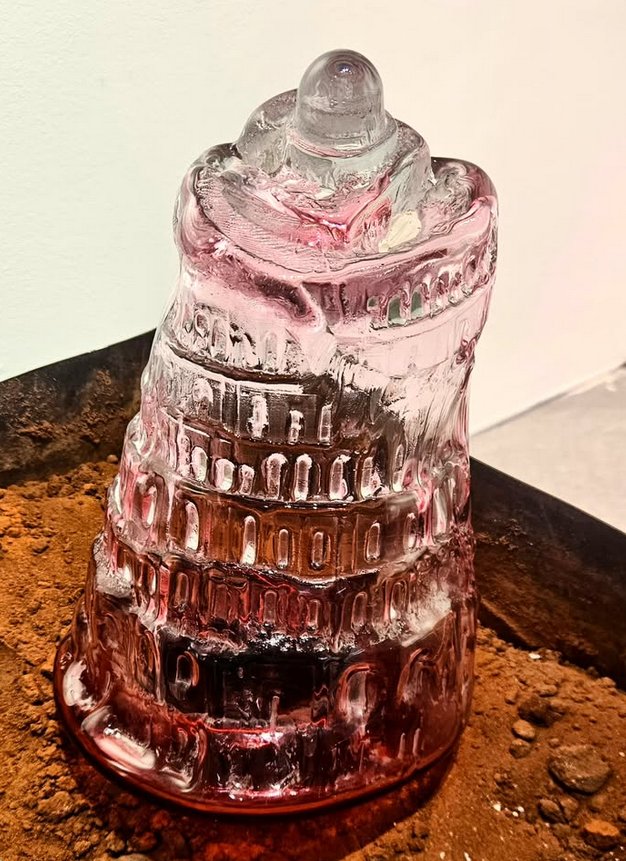
A cake and the Tower of Babel sit at almost the same point in latent space. I found them there by thinking the way the network thinks before I built it: form it in tiers, let everything taper upward, until the celebration and the construction share one silhouette. Then I trained a model of 47 million weights to walk the short distance between the two points, and blew the stops into glass. Six objects, between ten and thirty-five centimetres, on a tray of casting sand. The sand under them is the material glass is formed in, a step in production that happened to follow the work into the room.
The first thing you see is form. The cake and the tower share a grammar, tier over tier narrowing toward the top. The form also carries the meaning. The model set the two points side by side because they share something I had not seen until I walked through it. The tower rises toward God. The cake toward a birthday that is never meant to end. The same upward movement, toward something without end, though one rite is sacred and the other worldly. The birthday is the vertical gesture we kept after him, a piety with no one to address.
Babel is the word that makes the link possible. It most likely comes from Bab-ili, the gate of God, but the story reads balal into it, confusion. One name holds the entrance and the collapse. That is exactly what the model is to me. A gate to connections I could not see, and a confusion, because the moment I see them the model and I are speaking about the same image in two languages that do not translate. The punishment at Babel was that everyone suddenly spoke differently. The tower was left standing. The fragmentation was punishment enough, and it turns up already at my worktable.
Glass is where I force the meaning to commit. To call the network a material is an act, and glass is the test of whether the act holds. Whatever does not survive the translation from weight to volume falls away, and what remains on the tray is the object's actual claim. A spade stands in the sand with a hand grown into its shaft. The hand is the system's, the form came out of a prompt. Where does the tool end and the hand that holds it begin? The spade gives no answer. It is made never to disappear into the hand as a tool that works.
So I built a third pair of eyes. I have studied networks and built networks to learn to think like a network that is meant to think like a human, and the glass objects speak a third dialect that neither the model nor I command alone. Whether the collective attempt to understand ends like Babel, with each of us speaking a language of our own, I do not know. I have taught a model to walk the short way between a cake and a tower, and blown them into glass so that I can hold them. The rest is a suspicion that the gate and the confusion were spelled the same all along.